Sixty-five thousand First Nations’ households across Australia access electricity through prepayment supply arrangements that mean they can experience disconnection rates as high as an average of 59 disconnections per year, a landmark new report shows.
The Right to Power – Keeping First Nations communities on prepayment connected is being launched today at Parliament House Canberra, with members of the First Nations Clean Energy Network, Original Power, Energy Consumers Australia, and First Nations’ research partners and community representatives addressing the report’s key findings and recommendations.
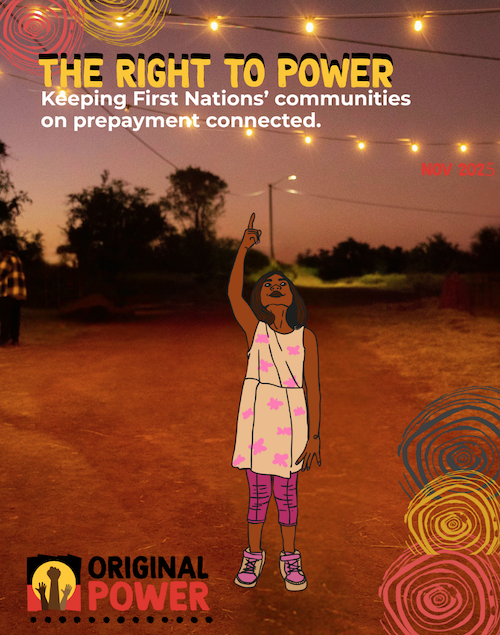 “Despite prepayment being the default and an expanding supply arrangement for thousands of First Nations’ households, it has operated with minimal policy or regulatory scrutiny until now,” says Lauren Mellor, a co-author of the report and co-Director of Original Power’s Clean Energy Communities Program.
“Prepayment exacerbates energy insecurity for low-income households by automatically disconnecting households from essential energy services when meter credit runs out.”
This report is the first national investigation into how prepayment supply arrangements are undermining health, wellbeing and economic participation for First Nations’ communities, with disconnections primarily driven by affordability and extreme heat challenges.”
The report, funded by Energy Consumers Australia, is based on extensive research including hundreds of prepayment household and service provider interviews, and analysis of smart meter data of household energy use and disconnection among First Nations communities in the Northern Territory, Western Australia, Far North Queensland and South Australia.
“We surveyed over 300 households to ask them how they felt about using power cards and prepay for energy. Most people liked that they could chuck in and help each other pay for power.
But disconnections create big problems keeping homes safe. Having fridges turned off means that food spoils and medicines go bad,” says Vanessa Napaltjari Davis, senior First Nations researcher at Tangentyere Aboriginal Corporation in Alice Springs.
“While some of our communities prefer prepayment to getting a big power bill, every person deserves fair access to affordable energy.. A majority of communities surveyed understood that rooftop solar could help reduce costs, but government housing department policies are still a major barrier to customer choice.”
“There were 440,000 disconnection events impacting 8,878 households across three States and Territories during a 12-month period. This data captures the experiences of households across four of the five prepayment retailers in Australia. Ergon Energy Queensland was the only retailer not to provide data for the study,” says Dr Tom Longden, the project’s lead research partner at Western Sydney University.
“Prepayment households experienced an average of 49 disconnections per year. The Northern Territory was the worst performing jurisdiction, with Power and Water Corporation customers experiencing an average of 59 disconnections each year.”
“Extreme heat worsens energy insecurity and we found that disconnections more than double on days over 40 degrees. People need help to stay connected during extreme events, including the hottest days of the year. Other dangerous events include cold weather, high humidity, cyclones, and flooding,” says Dr Tom Longden.
In South Australia, where prepayment was introduced in 2022, the report finds it is possible to make prepay fairer with more affordable energy and stronger regulation.
“SA communities have much lower disconnection rates, due in part to a reduced tariff combined with the introduction of solar microgrids to offset generation costs in prepayment regions. Ability to use upfront direct debit options like Centrepay support households to budget ahead, and the retailer is required to provide financial hardship support when needed,” says Glen Wingfield, an Arabunna man and SA Coordinator for the First Nations Clean Energy Network.
80% of respondents nationally said disconnections meant they were unable to safely store food. Three-quarters could not keep homes at safe temperatures during extreme hot/cold weather.
Dr Brendan French, Energy Consumers Australia CEO says, “This vital report shows too many people in these communities are denied consumer protections that people living in Sydney and Melbourne have as a matter of course. At a time when protections for most Australians are improving, the people in communities supplied by prepayment arrangements are locked out and the energy divide increases.
"We need urgent action by regulators and governments to improve the experiences of First Nations communities and ensure energy is accessible for all, regardless of location, billing arrangements or income level."
The report makes six recommendations for prepayment reform with the aim to keep people connected to power, including establishing a Priority Services Register to improve coordination of support for prepayment and other vulnerable consumers, protection from disconnection during extreme heat, and improved access to lower cost renewable energy options.
Read the report